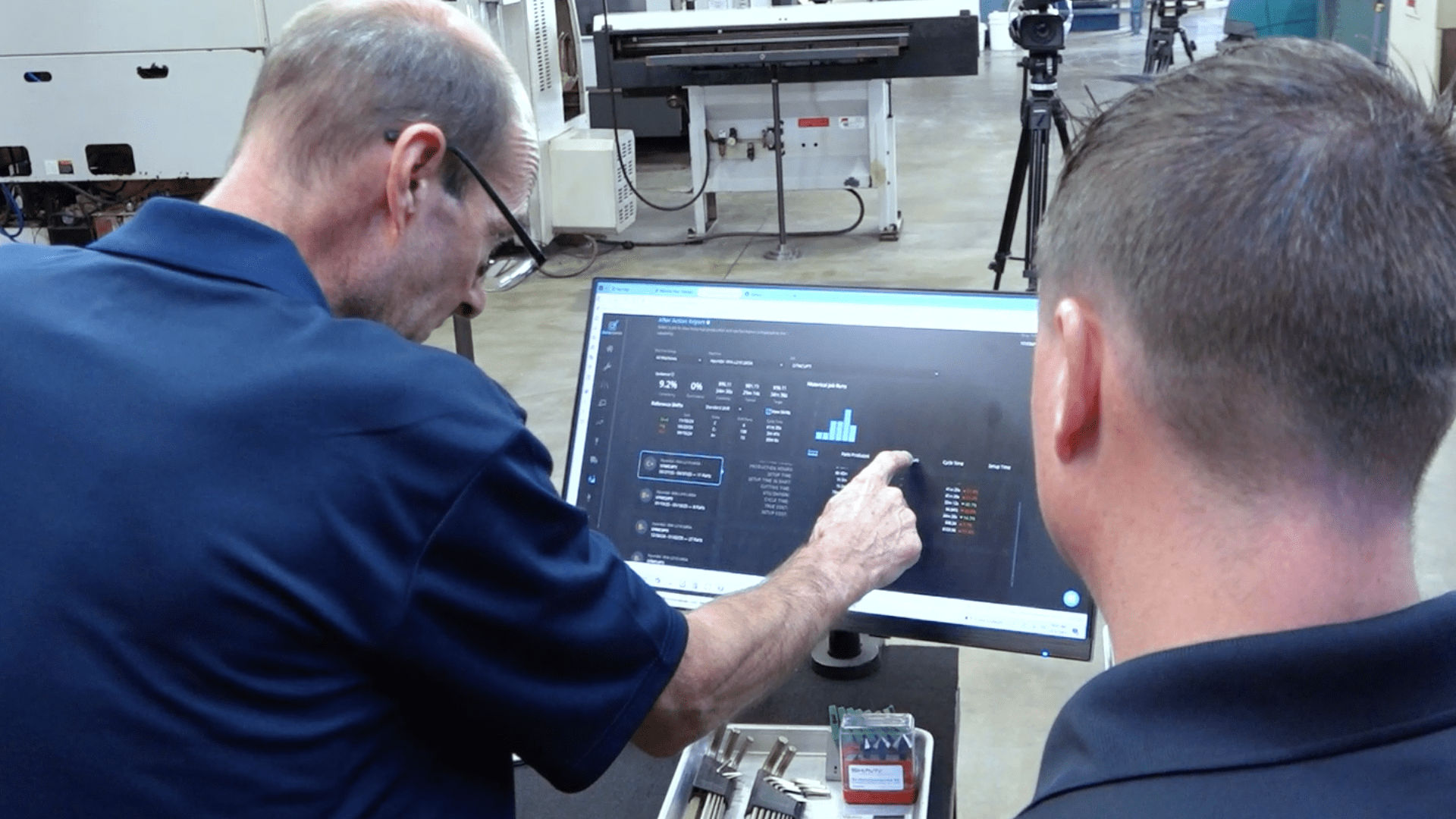
VIDEO: How Neo Industries Optimized Cycle Times, Reduced Downtime 19%, and Built a Path to Automation in Their Small Shop
Neo Industries Proves That Process Discipline, Backed by Machine Data, Is How Small CNC Shops Compete and Win
There’s a story people tell themselves about machine monitoring. It goes like this: that’s for the big shops. You need 50 machines, 100 machines, and a serious IT department. You need scale before the investment makes sense.
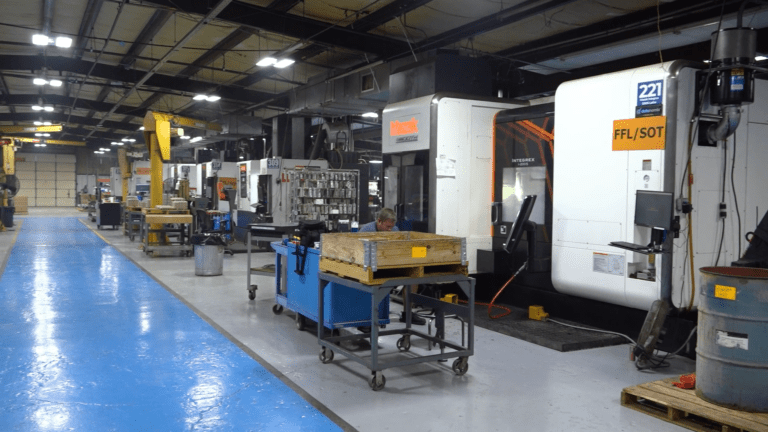
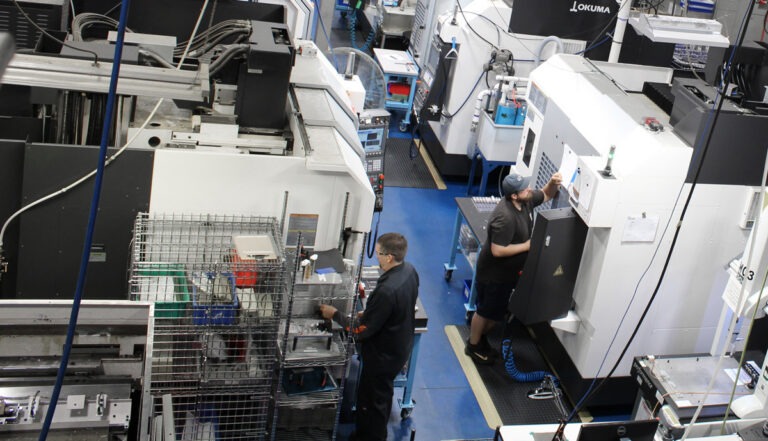
Bob McGregor runs Neo Industries in Colleyville, Texas. He has a small cell of CNC machines. And he’s proving that story wrong.
Watch the full interview with Tony Gunn and Bob McGregor.
The Assumption That Holds Small Shops Back
Most small job shops run on experience and intuition. You’ve run this part before. You think it took about 30 minutes. You believe the tools are dialed in. You feel like things are improving.
Bob knew that feeling wasn’t enough. “Everything that goes on in that machine gets captured,” he explains, “we analyze from run to run, batch to batch, and try to always improve our process.”
That’s not a complicated idea. But without the data to back it up, it stays a guessing game. Datanomix gave Neo Industries the ability to stop guessing.
What Process Improvement Actually Looks Like
Neo Industries takes on difficult, tight-tolerance work, including titanium parts with 24 to 36-hour turnaround expectations. These aren’t the jobs where you can afford to leave time on the table. Bob walked through one example: a titanium part that started at 32 minutes per cycle. Using Datanomix to analyze which tools were consuming the most time in the cut, his team kept optimizing. From 32 minutes to 21, and eventually down to 10. That’s not a one-time win. That’s what continuous process improvement looks like when you have the data to drive it.
That’s a 34% reduction in cycle time on a single job. On a bar-fed machine running 10, 50, or 500 parts, the math gets meaningful fast.
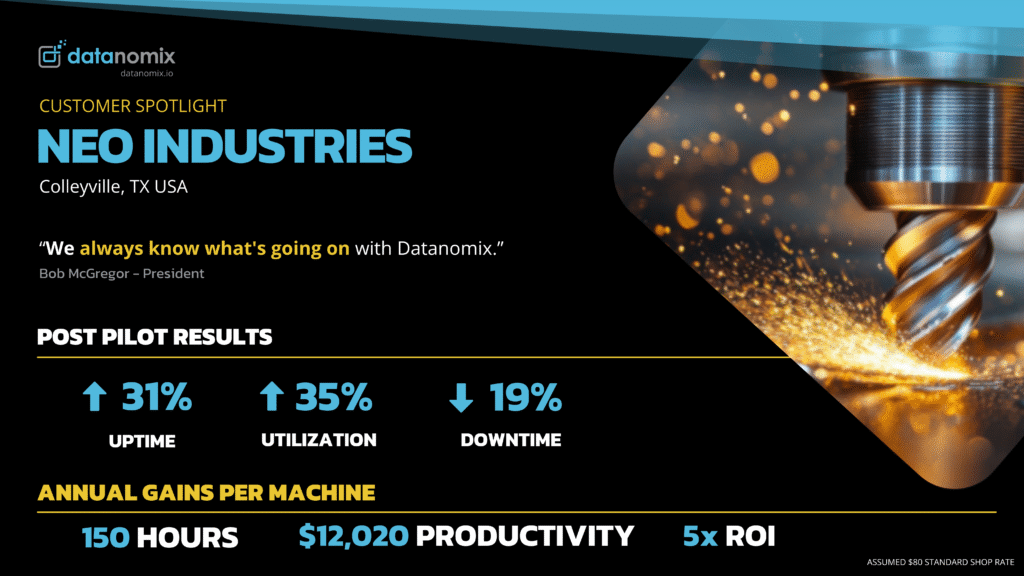
Their post-pilot results confirmed what that kind of discipline produces across the operation. Neo Industries increased uptime by 25%, utilization up 35%, and downtime down 19%. Those aren’t vanity metrics. That’s the shop getting more productive output from the exact same equipment. At 150 additional productive hours per machine annually and $12,020 in productivity gains, the ROI case for Datanomix is straightforward: a 5x return.
Tool Path Decisions Backed by Data
One of the things Bob described that should resonate with any machinist running complex parts: knowing where to invest your attention.
“Datanomix tells us which percentage of the cut is allocated to which tool. If I have to buy a $600 tool or insert, but I’m going to get three minutes a piece back, it pays off pretty quickly.”
– Bob McGregor, President at Neo Industries
That’s not guesswork. That’s data-driven process improvement. You’re not buying tooling because it might help. You’re buying it because the numbers show exactly where the bottleneck lives and what it’s costing you per part. For small shops where every purchase matters, that kind of clarity is worth its weight in gold.
The Real Goal: Reliable, Minimally Attended Operations
Bob didn’t implement Datanomix just to win a one-cycle-time battle. He’s building toward something bigger.
“We try to leverage a small amount of human resources and capital resources as best we can,” he says. “We have to have reliable processes that can be minimally monitored by people. We can always know what’s going on with Datanomix.”
That’s the roadmap for unattended operation. When your processes are dialed in and your data is live, the shop can run without someone hovering over every cycle. For a small shop competing on speed and quality, repeatability makes it possible to take on more work without increasing overhead.
Small Shops Are Not a Compromise Case
This is worth saying directly: small shops don’t get a stripped-down version of what’s possible with production data. They get access to the same solution with Datanomix.
No matter the shop size, you still need to know your cycle times. You still need to understand where your tooling dollars are going. You still need reliable processes that don’t require a person standing at every machine. The fact that you have six machines instead of forty doesn’t change the math. It might actually make the math more critical. In a small shop, every machine matters more, every hour of downtime hurts more, and every process improvement compounds faster.
Neo Industries is proof of that. They’re a small shop doing difficult work on difficult materials, with aggressive delivery expectations, growing lean. That’s the future of precision manufacturing in the US. And it runs on data insights.
The Bottom Line
If you’ve told yourself that machine monitoring is something you’ll think about once you grow, Neo Industries is the reason to reconsider that timeline. Bob McGregor didn’t wait for scale. He used production data to build scale. He’s cutting cycle times by a third on titanium, improving uptime 25%, pushing utilization up 35%, and cutting downtime nearly 20%. And he’s doing it with a handful of machines in the Dallas-Fort Worth suburbs.
The machines are ready. The data is there. The question is whether you’re looking at it.
If you’re running a small or mid-sized CNC shop and wondering whether monitoring makes sense at your scale, the answer is in the numbers.
Request your Pilot today and let us show you what it looks like for your operation.
FIRST DOWN WEBINAR SERIES:
Moving the Chains in Production & Performance
Steady progress doesn’t come from one big play. It’s built one first down at a time.