
VIDEO: Unlocking Hidden Capacity in High-Volume Fabrication
How Right Angle Steel Increased Uptime 41% Without Adding New Equipment
Right Angle Steel operates in one of the most competitive corners of manufacturing. High-volume laser cutting. Press brakes. High-mix orders. Aggressive quoting. Customers who expect fast turnaround and flawless execution. And in today’s market, plenty of competitors with similar equipment. “Especially since COVID, it seems like everybody has a laser,” says Josh Cook, President of Right Angle Steel.
When growth pressure builds in this environment, the answer is usually straightforward: add another machine. Right Angle Steel chose a different path. By implementing real-time production monitoring across their fabrication operation, the team increased uptime 41% and expanded overall capacity 45% without adding equipment or headcount.
For a capital-intensive fabrication shop, that changes the growth equation.
A Refusal to Leave Performance on the Table
Before this became a technology story, it was a mindset story. Josh describes the culture at Right Angle Steel in one phrase: “indefatigable efforts.” A refusal to fail. A constant push to do something better today than yesterday shaped how they approached growth.
“It’s constantly pushing the limits of people, machines, and technology.
How can we do something better today than we did yesterday?”
– Josh Cook, President at Right Angle Steel
Fabrication shops and CNC operations are built around machines. When demand increases, the instinct is to add more of them. More lasers. More machining centers. More automation. Right Angle Steel asked a different question: Are we fully utilizing the equipment we already have?
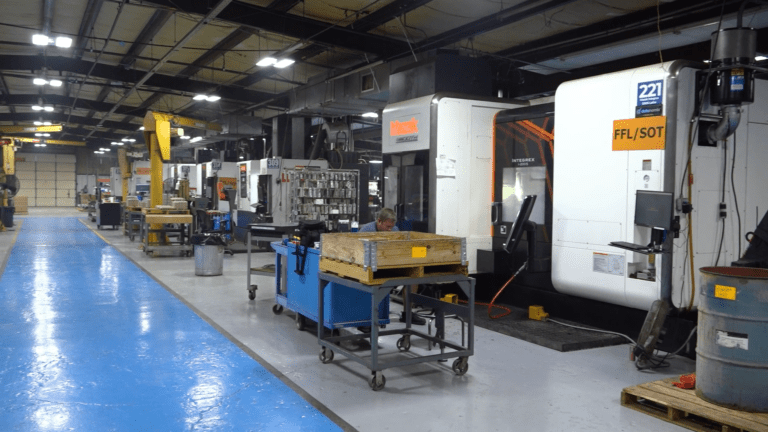
As a 100,000+ square-foot fabrication operation running a mix of short and long production runs, performance variability can get lost in day-to-day noise. Small inefficiencies between jobs. Minor downtime that no one flags. Cycle inconsistencies that average out on paper. By connecting their equipment to Datanomix production monitoring, those blind spots became measurable.
“Being able to see in real time with accurate data when a machine is running and what it’s doing when it’s not changes everything.”
– Josh Cook, President at Right Angle Steel
With that visibility, improvement became intentional. Conversations shifted from assumption to accountability. Performance stopped being estimated and became measured. Growth no longer meant adding equipment first. It meant demanding more from the existing operation. And in high-volume fabrication, demanding more from the operation means protecting margin at every level.
Protecting Margin in High-Volume Production
High-volume fabrication runs on tight margins. Laser cutting work is competitive. Customers closely compare pricing, and many are evaluating whether to bring production in-house. “You’re quoting on a very cutthroat level against all kinds of different people,” Josh explains. In that environment, margin erosion rarely stems from a single major breakdown. It comes from small, unnoticed inefficiencies that accumulate. Average cycle times may look acceptable on paper, while variability quietly eats into throughput.
“You might average 15 seconds, but if 100 parts ran at 45 seconds, you need to know why.”
– Josh Cook, President at Right Angle Steel
That shift from looking at averages to identifying anomalies was critical. Datanomix machine monitoring allowed Right Angle Steel to isolate those inconsistencies, understand their root causes, and tighten execution. The outcome was a 30 percent reduction in common waste and approximately 300 additional productive hours per machine annually. At an estimated $24,000 in productivity gains per machine, performance improvements translated directly into stronger margin protection.
In high-volume production environments, protecting margin is not about squeezing costs. It is about eliminating variability and reclaiming the capacity that inefficiencies quietly consume.

Turning Speed Into a Data-Backed Customer Commitment
Right Angle Steel built its reputation on responsiveness. Customers count on fast turnaround, often inside tight windows. But speed without control creates risk. “If you plug in ten hours of work and the schedule falls behind, you need to know why,” Josh explains.
As the operation expanded to more than 100,000 square feet and 65 employees, relying on instinct and manual tracking became harder to sustain. Leadership needed confidence that production schedules reflected true machine capacity. Datanomix Production Monitoring provided that clarity.
By aligning scheduling decisions with actual uptime and performance data, the team strengthened its ability to commit to lead times confidently. Instead of hoping a packed schedule would hold, they now understand when machines are running, when they are not, and how that affects on-time delivery. For fabrication shops and CNC job shops managing high-mix production, this level of visibility turns speed into a reliable promise rather than a risky assumption.
Scaling Lean Instead of Scaling Overhead
Growth brings complexity. More jobs. More variability. More pressure to answer performance questions quickly. Right Angle Steel is intentional about staying lean as it expands. “We want the people on the floor to be the ones making the money,” Josh says. “The more overhead you have, the less you can pay the people that are on the floor.”
Rather than hiring layers of administrative staff to manage reporting and scheduling, the company uses connected machine data to drive decisions. Performance insights flow directly from the equipment to leadership, reducing reliance on spreadsheets and manual follow-up.
Their long-term vision is for a fully connected fabrication operation in which quoting, ERP, and machine performance align. Orders come in. Capacity is known. Lead times reflect real conditions.
For manufacturers focused on sustainable growth, scaling lean is not about doing more with less. It is about doing more with clarity.
The Bottom Line
Right Angle Steel did not expand capacity by adding machines. They expanded capacity by increasing visibility and accountability on the shop floor. In high-volume fabrication and CNC production environments, that shift reshapes profitability, strengthens scheduling confidence, and supports long-term growth. Machine monitoring is not about watching machines. It is about unlocking performance, protecting margin, and building an operation that can scale without losing control.
“At some point, you can’t go on gut feel anymore.
You have to have the data to back it up.”
– Josh Cook, President at Right Angle Steel
If your team is ready to improve operational consistency, increase capacity, and quote with confidence, Datanomix can help. If you are running a fabrication shop or CNC operation and feeling pressure to invest in more equipment, the better starting point might be this: Are you already using everything you have?
RELATED WEBINAR:
From Spreadsheets to the Digital Thread: One Shop’s Journey Through the Messy Middle
Building a real digital thread is messier than anyone admits. Right Angle Steel shares what it takes.