
The Digital Thread: Where Precision Manufacturing Breaks Down
Your systems aren’t broken. They just don’t talk to each other. Here’s what precision manufacturers told us about where the thread snaps and what to do about it.
Most precision manufacturers have the right systems in place. A CAM system. A CMM. An ERP. Machine monitoring. The investments are there.
The problem is that none of them talk to each other, and the team ends up filling the gaps manually. Chasing revisions. Tracking down status updates. Reacting to problems that have already cost them time and money.
That’s not a workflow. That’s fire-fighting with extra steps.
Greg McHale, Founder and CEO of Datanomix, and Hiren Kumbhojkar, Head of Product Management at Hexagon Manufacturing Intelligence, sat down to kick off the Manufacturing Digital Workflows webinar series with a direct conversation about where the digital thread breaks in precision manufacturing and what it actually takes to fix it. The manufacturers in the room weighed in too, and what came back was honest, a little uncomfortable, and exactly what we expected.
“The concept of digital thread sits on top without interfering with their daily work. But still allows the connectivity and traceability of data across the entire chain.”
— Hiren Kumbhojkar, Head of Product Management at Hexagon Manufacturing Intelligence
The Thread Snaps at the Handoff
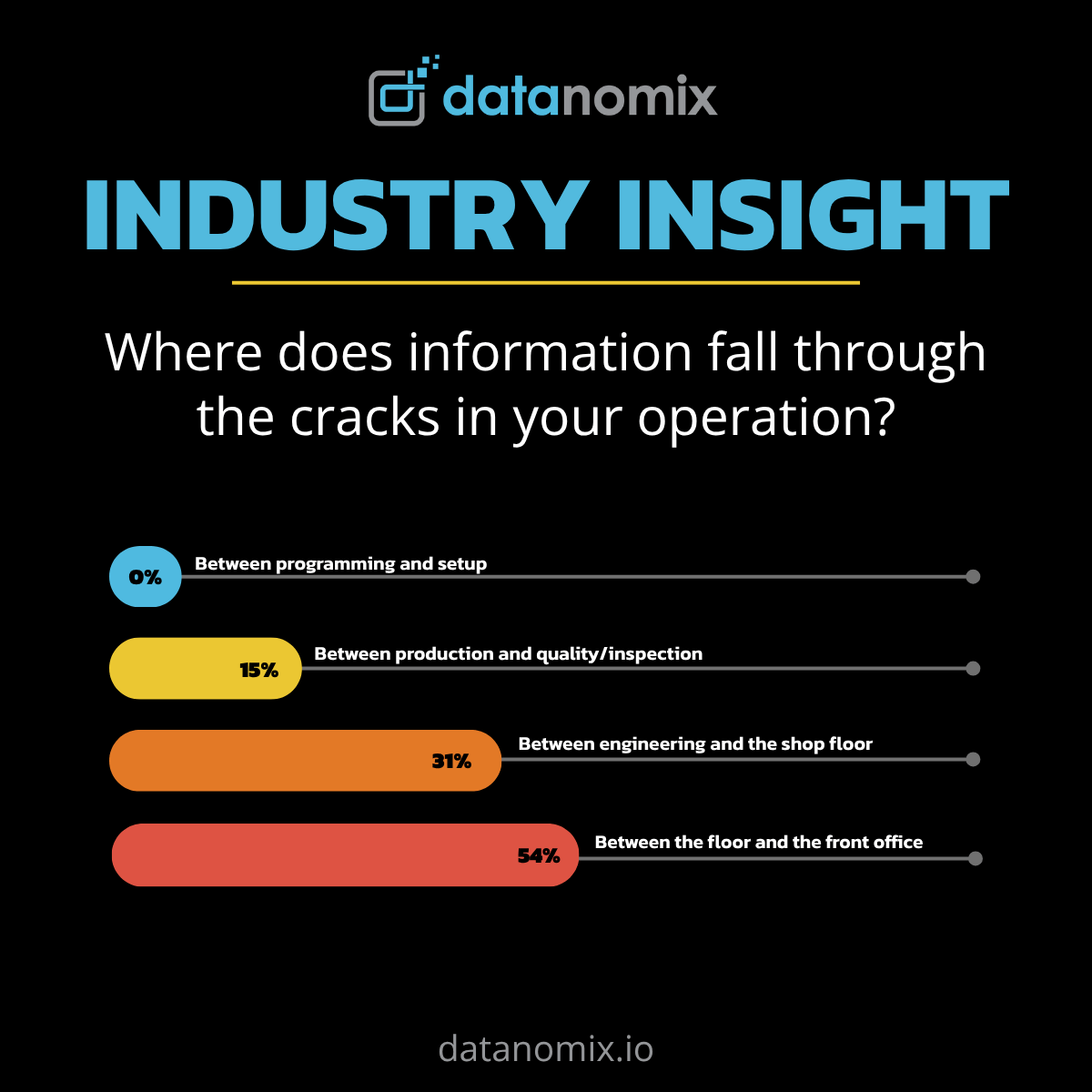
Every part that hits your floor has a business plan behind it. A quoted cycle time. A target setup time. Material costs. Tooling assumptions. That plan gets built in the front office, handed to engineering, translated into a program, put into a work order, and pushed to the floor. And somewhere in that chain, the business plan stops traveling with the job.
By the time the operator runs the part, the context that made the quote make sense is gone. Nobody told them what they were supposed to hit. And when they miss it, nobody connects that back to the original estimate.
The biggest gaps aren’t inside any one system. They’re in the handoffs between them. When precision manufacturers weighed in on where information most often falls through the cracks, 85% pointed to the transitions between departments. More than half specifically called out the gap between the floor and the front office.
“It’s not just a quote or an estimate. It is actually the business plan for the part, and embedded in the idea that it’s the business plan is how you’re going to make money.”
— Greg McHale, Founder and CEO of Datanomix
The Business Plan Has to Travel All the Way to the Floor
The blueprint makes it from engineering to the work order. The setup sheet, the tooling sheet, the cycle time, and the program should all land together. But then something breaks. What you quoted to protect the business and what you gave the floor to hit are often two different numbers. And if those numbers aren’t tied to each other, you have no way of knowing whether you made money on the job until long after it shipped.
“Traceability between what’s planned and what gets executed is very difficult to find out and maintain because that deviation has a direct impact on profitability, performance, or quality.”
— Hiren Kumbhojkar, Head of Product Management at Hexagon Manufacturing Intelligence
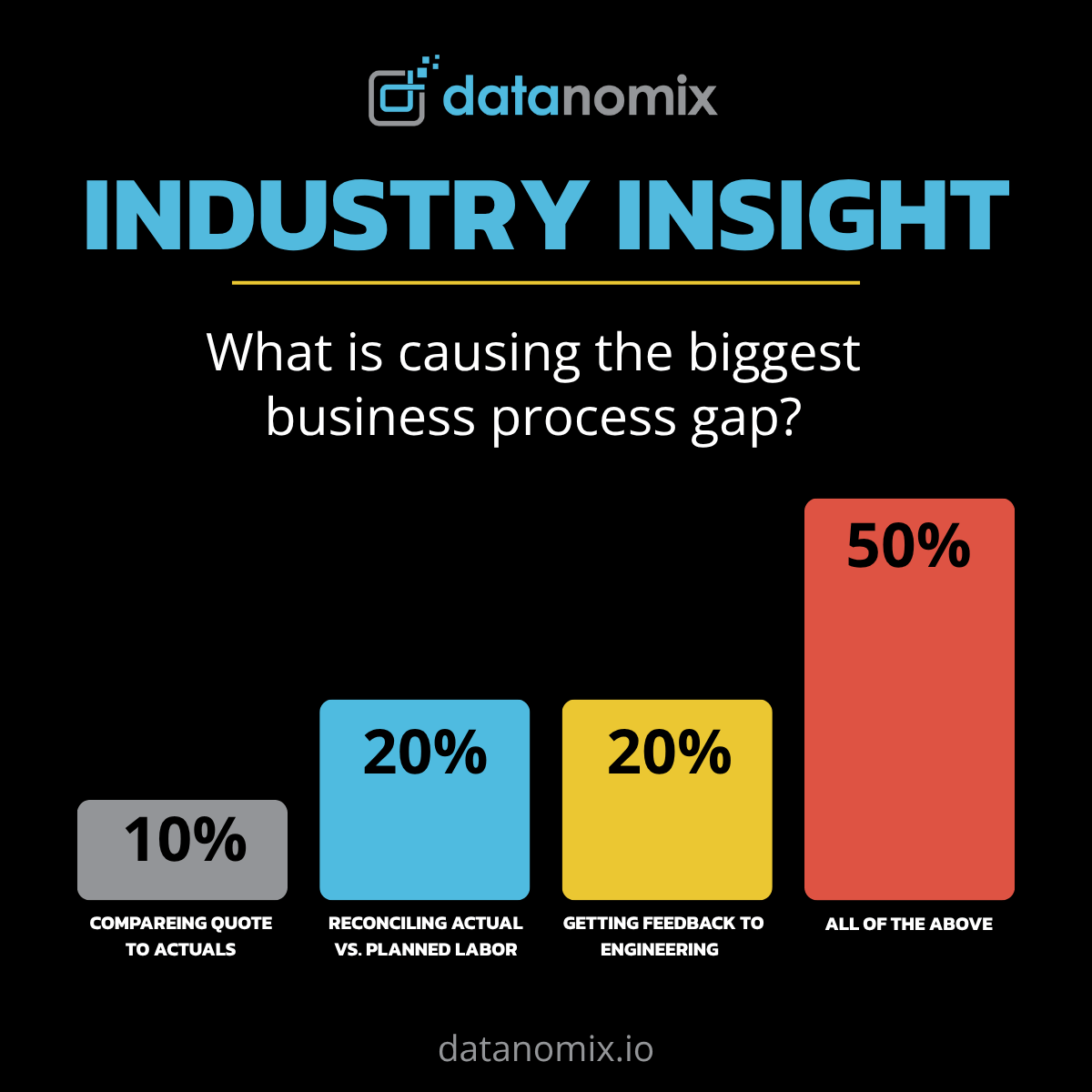
When we asked manufacturers to rank what’s causing the biggest business process gap, half said all of the above! The rest is split between comparing the quote to actual performance, reconciling actual versus planned labor, and providing engineering with feedback on what actually happened on the floor.
That answer confirms what most shops already feel: this isn’t one broken link. It’s the whole chain.
One practical place to start closing this loop is at the program level. The Datanomix G-Code Cloud integration with Hexagon’s Esprit EDGE automatically syncs files into version control the moment a program comes out of CAM.
No second workflow. No extra steps. The G-code file stops being just something that runs the machine and starts being a vehicle for knowledge transfer, carrying target cycle times, setup times, and tooling information all the way to the floor.
“90% is mostly or partially disconnected. That’s pretty much what we expect because this just isn’t simple and it isn’t straightforward.”
— Greg McHale, Founder and CEO of Datanomix
90% of Manufacturing Systems Are Disconnected. That Number Tracks.

Nine out of ten manufacturers said their systems are mostly or completely disconnected. Not partially. Not working on it.
This isn’t a technology problem. It’s a structural one. Every area of a manufacturing business has a tool that works well for that area. Those tools weren’t built to talk to each other. And without a layer of connectivity sitting above them, the data stays trapped in silos shared only when someone asks for it, usually after a problem has already hit production.
This is exactly where production monitoring, G-Code Cloud + DNC, and ERP Insights do their most important work. Not by replacing the systems already in place, but by surfacing what’s happening between them and closing the loop across departments that have historically operated independently.
The Barriers Are Real. But They’re Not Insurmountable.
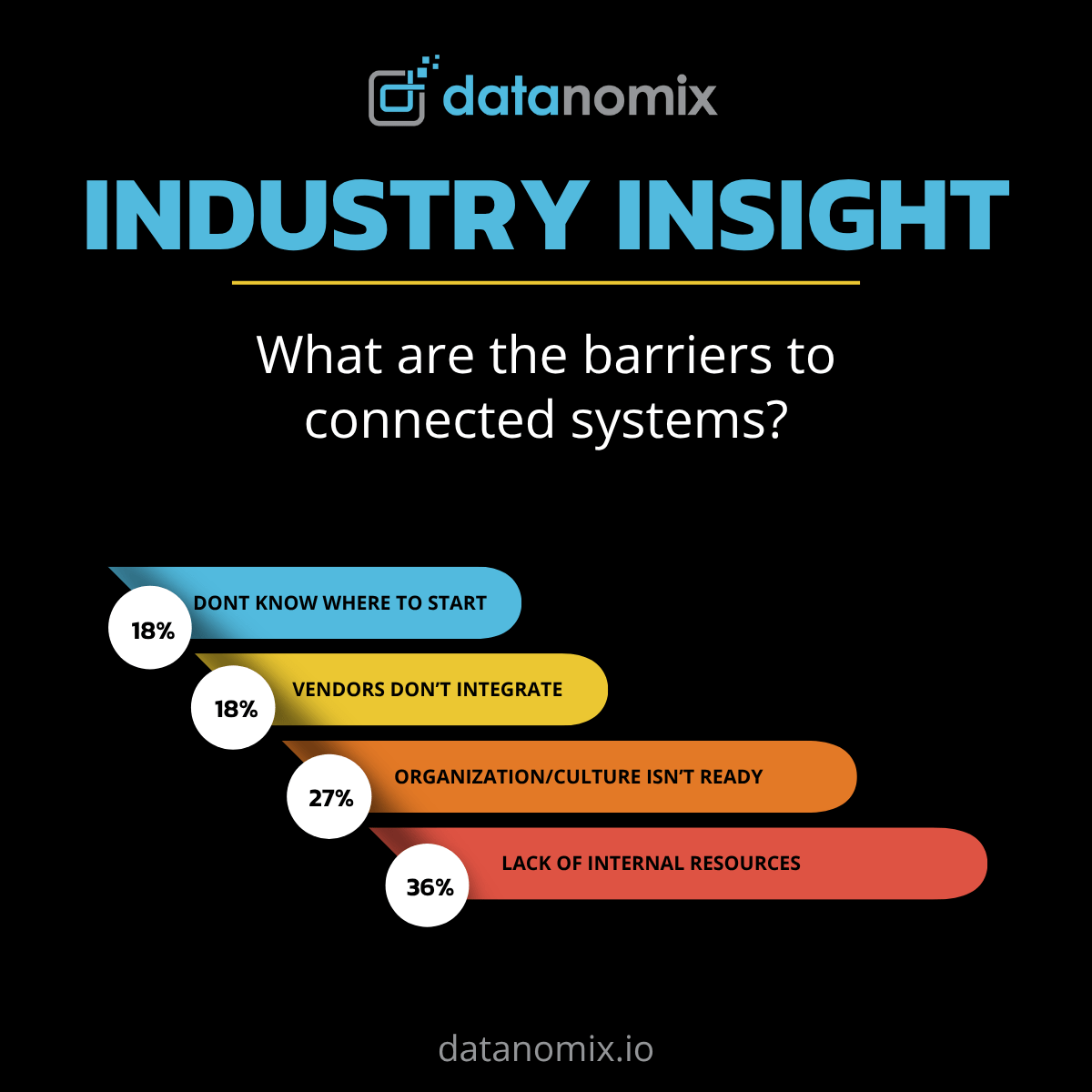
When manufacturers said they were mostly disconnected, the follow-up question was obvious: what’s in the way? Lack of internal resources came in at 36%. Organizational culture not being ready was 27%. Vendors not integrating well and not knowing where to start tied at 18% each.
If the biggest barrier is resources, it means the problem feels complicated, and that’s on vendors to fix. If the culture isn’t ready, it means whatever change is coming looks disruptive. Both of those barriers point to the same solution: start smaller than you think you need to.
Connect planning and preparation. Connect preparation and execution. Close one loop, prove the value, and build from there. That’s how the shops that are seeing real results got there.
CUSTOMER SPOTLIGHT:
Why Automation Without Data Visibility Falls Short, and How Reata Engineering Got It Right
“I don’t think of this end-to-end process as something that you need to start overnight. There is value in individual connections. It can start with where your most promising business pain points are today.”
— Hiren Kumbhojkar, Head of Product Management at Hexagon Manufacturing Intelligence
“It’s really early innings on trying to get stuff connected and trying to understand where the biggest value is in getting things connected.”
— Greg McHale, Founder and CEO of Datanomix
Most Shops Are Just Getting Started
36% of manufacturers are just getting started. 27% have made some investments but aren’t fully connected. 21% are connected but not getting full value. Only 14% said they’re fully connected and seeing measurable results.

That 14% is the proof point. It’s possible. It’s happening at real shops right now:
- Hill Manufacturing built a connected workflow from their quoting process all the way through to machine data collection and quality measurement.
- Josh Cook, President of Right Angle Steel, thought he was running at 75-80% utilization. Once the data came in, the real number was 45%. That gap didn’t just change how he monitors the floor; it rewrote how he quotes.
- Reata Engineering went the other direction on purpose. Before they bought a single piece of automation, they connected their ERP to live machine data, so the schedule and the floor finally told the same story. That foundation is what made their automation investments pay off: 27% more uptime, 28% more utilization, and a 7x return on their Datanomix investment.
The path for these shops wasn’t one big implementation. It was a series of connections, each one closing a specific gap that was costing time and money.
“A lot of times, that data either remains in a silo or gets shared in an extremely disconnected manner, only when requested. And that is the big value of connecting the data.”
— Hiren Kumbhojkar, Head of Product Management at Hexagon Manufacturing Intelligence
Where the Floor Goes Dark

80% of manufacturers said the setup and first article, or the in-process machining and monitoring, are where they have the least visibility. That’s where preparation and execution live, the exact stages where the business plan either survives the translation or gets lost for good.
If you don’t know what’s happening during setup, you don’t know whether your first article will pass. If you don’t have visibility into machining in-process, you’re reacting to problems that already happened instead of intercepting them in real time.
Getting the right information to the right people at the right time is not a nice-to-have. That’s where margin lives or dies.
Start Where It Hurts Most
The instinct when a problem feels this big is to try to solve it all at once. That’s the wrong move. Start with your most pressing business pain point. Connect two systems that should have been talking to each other. Close one loop. Then the next.
The Datanomix and Hexagon partnership was built around exactly this idea: giving precision manufacturers practical, incremental connections that deliver real value without requiring a full transformation to get there.
The full conversation between Hiren and Greg covers more ground than we could fit here. Watch the on-demand webinar to see the digital thread in action and hear what it looks like when your systems finally start talking.
Ready to have a connected workflow in your shop? Request your pilot, and we’ll show you where to start.
FEATURED WEBINAR SERIES:
Manufacturing Digital Workflows
Turning shop-floor data into predictable performance.