How to Make More Money in Precision Manufacturing with Production Monitoring
Three plays that growth-minded shops run to increase revenue without buying a single new machine or hiring a new person.
You Made the Schedule. Now You’re Hoping It Happens.
You quoted the work. You bought the steel. You built a schedule that looks great on a screen, and then you walked out onto the floor and realized that the schedule depends on a hundred small things going right, most of which you can’t see in time to fix.
That’s not a planning problem. That’s a visibility problem. And it’s the difference between a shop running at 40% utilization and one running at 55% with the same people, same machines, and in the same building.
The fastest way to make more money in precision manufacturing isn’t to buy more capacity. It’s getting more out of the capacity you already paid for.
FEATURED WEBINAR:
Unlocking Capacity You Already Own
If you’re looking to increase output without increasing footprint or headcount, this conversation offers a practical look at how to unlock the machine efficiency you already own.
The Math Most Shops Haven’t Done
Most shop owners think they’re running at 80% utilization. When the machines start telling the truth, the real number is closer to 40%. That gap isn’t a moral failing; it’s just what happens when nobody can see what the machines are actually doing.
When shops run our Pilot Program, here’s what they reclaim in the first 90 days:
- 15% more parts — out of the same machines, same operators
- 27% better cycle times — without changing the work
- 12% faster time-to-first-part — every shift starts cutting sooner
Translated into a single number: the average shop picks up 30+ extra minutes per machine, per shift in the first month. For a 20-machine shop running one shift, that’s 10 extra machining hours per day. Annualized, it’s a six-figure line on your P&L that wasn’t there before.
You didn’t hire anyone. You didn’t buy a machine. You just stopped letting the time leak out.
The Three Plays That Make It Happen
1. TV Mode on the Shop Floor
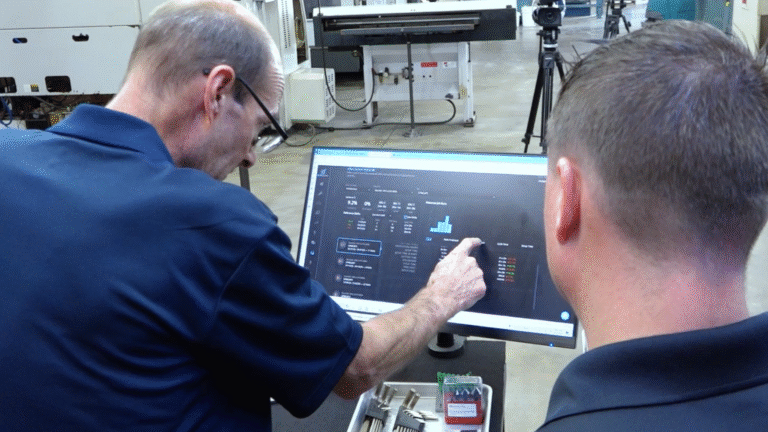
Broadcast which machines are down, why, and for how long — on screens the whole floor can see.
The minute time-to-first-part and downtime go on a screen, every machine starts cutting sooner. Not because anyone’s getting yelled at. Because nobody wants to be the slow one on the board. It’s the cheapest accountability you’ll ever buy.
2. Real-Time Alerts
The minute attention is needed, the right people already know; at their desks, on the floor, on their phones.
No more waiting for the morning meeting to find out the spindle’s been down since lunch. No more walking the floor to discover what you should’ve known an hour ago. Time-to-resolution for most issues cuts in half.
3. Identify and Reduce Wasted Time
Every minute counts in high-mix, low-volume environments. Production monitoring surfaces the small, repeating losses nobody notices.
Slow shift starts. Downtime around breaks. The gap between the last part and the end of shift. Individually, they’re rounding errors. Together, they’re the difference between “we’re keeping up” and “we’re ahead.” Serve them up in real time. Kill them one by one. Watch the hours add up.
What “Making More” Actually Looks Like on the Floor
It looks like operators who don’t have to chase down what’s running. Supervisors who don’t have to walk the floor to find out what stopped. Owners who walk into Monday’s meeting with the same number their CFO is looking at, instead of three different versions of the truth.
It looks like the schedule is actually happening.
And it looks like a real dollar figure on your P&L—not someday, not after a year-long rollout, but in the first 30 days of your Datamix Pilot.
See What Your Number Looks Like
The fastest way to find out what Make More is worth to your shop is to plug in your numbers in our ROI calculator.
ROI Calculator
How much more could your shop be making?